CELANESE.COM DESIGN SYSTEM
How do you create a consistent UX for a global chemical company with diverse stakeholders?
COMPANY

EXPERTISE
Design System
UX
UI
ROLE
UX Designer
EXPERTISE
Design System
UX
UI
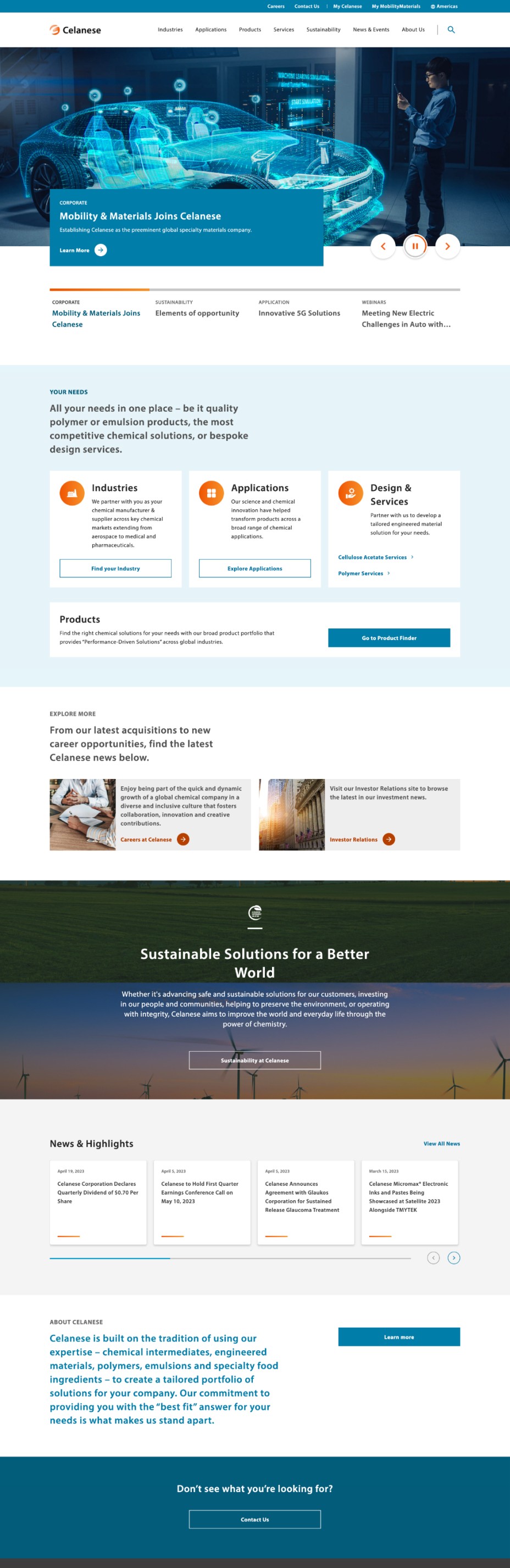
The Project
The Project
The Project
Designing a cohesive user experience while juggling a lot of opinions.
Background
Prior to the launch of the new Celanese.com in 2022, the site had deteriorated into an unmanageable mess of competing interests and a broken user journey. There were multiple, disconnected minisites for our larger product groups.
The new site fixed these problems with a fully responsive and comprehensive website that put the user’s needs first. Consulting and sourcing content were my main roles during the design phase.
My role after the site launched was to manage and enhance the system as the company acquired new products and businesses.
The Challenges
The Challenges
The Challenges
Challenge #1
Maintain a unified system while numerous people request changes.
Challenge #2
Communicate the capabilities of the design system to nontechnical stakeholders.
The Process
The Process
The Process
Research & Planning
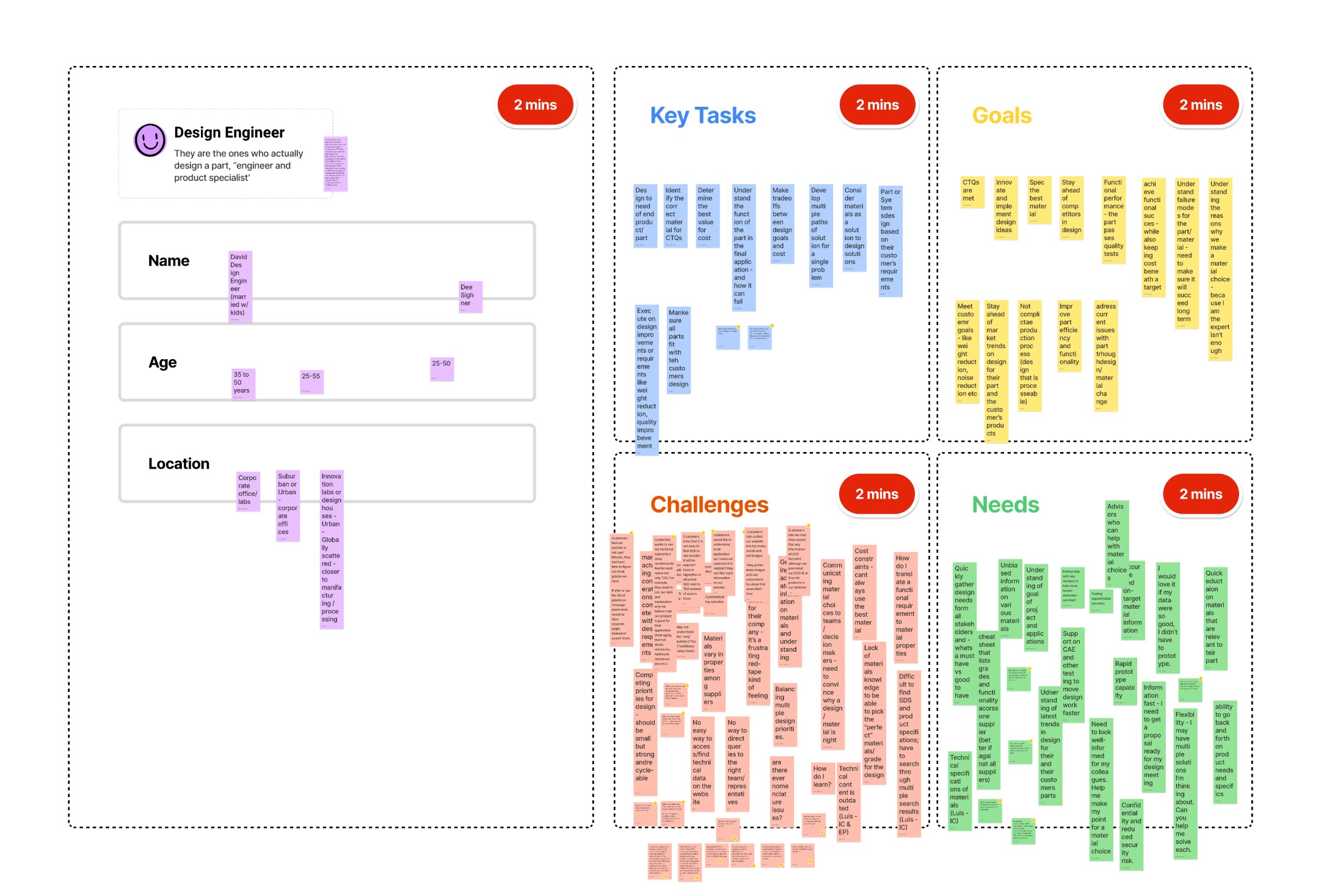
Recognized issues with responsiveness, inconsistent design, and embedded text in carousel images. Conducted workshops to understand user needs and create personas, aiding in shared understanding and reducing biases. Visualized user goals and redesigned site navigation for better usability and content indexing.
Design & Prototyping
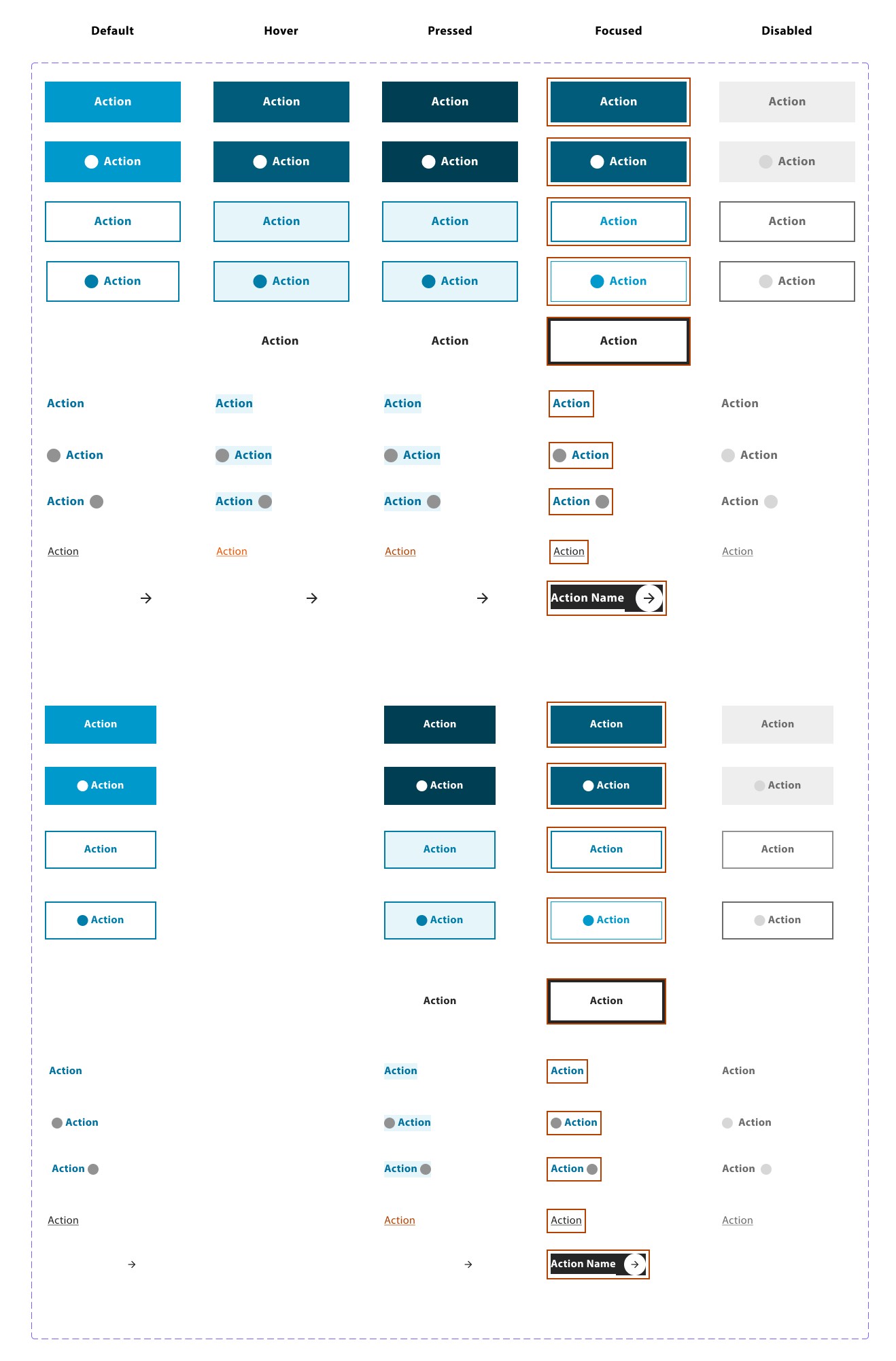
Developed and maintained a Figma-based style guide for consistent design and future growth. Created interactive prototypes to demonstrate UX design, improving client interaction and feedback.
Development & Implementation
Ensured design integrity and reduced time-to-market by reusing design assets and code. Made decisions on component usage and creation.
Testing & Optimization
Addressed layout issues and implemented solutions like alternating text/photo layouts. Managed design system to accommodate new content and business acquisitions. Participated in continuous testing as features were added.
where we started
Some of the challenges before redesigning: the website was responsive only using breakpoints so the content resized inconsistently, there was no design system so there were conflicting button and formatting styles, and the main carousel images contained embedded text.
Once we understood these and a number of other issues, we could start the process of who are users were and what they needed from the new website.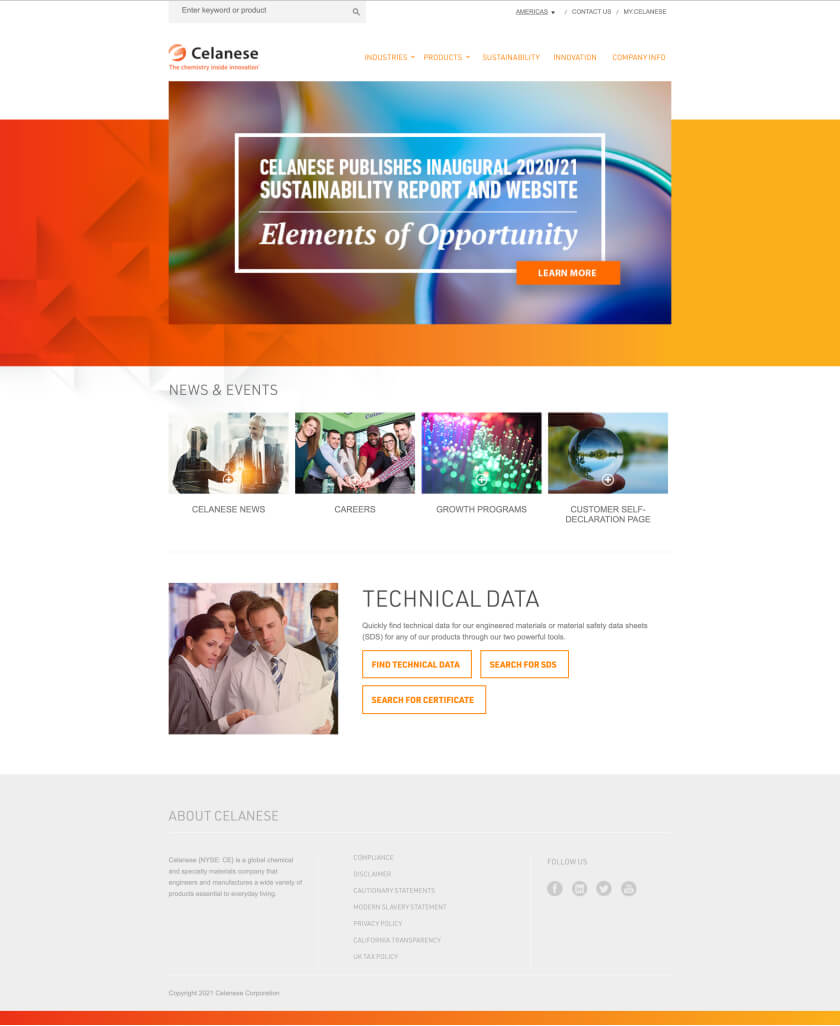
personas
Personas create a shared understanding of who the users truly are. In addition, they help our teams in having a common vocabulary. These personas helped us empathize, reduced biases, and reminded us to design our users' mental and behavioral models rather than our businesses' organizational or engineering implementation models.
user journeys & site map
A Journey Mapping workshop was conducted with the Celanese product managers and other stakeholders to visualize a user's process to accomplish a goal.
The Sitemap helped in redesigning the navigation for the site. It allows visitors and content authors to find specific pages in their hierarchy and aids in indexing.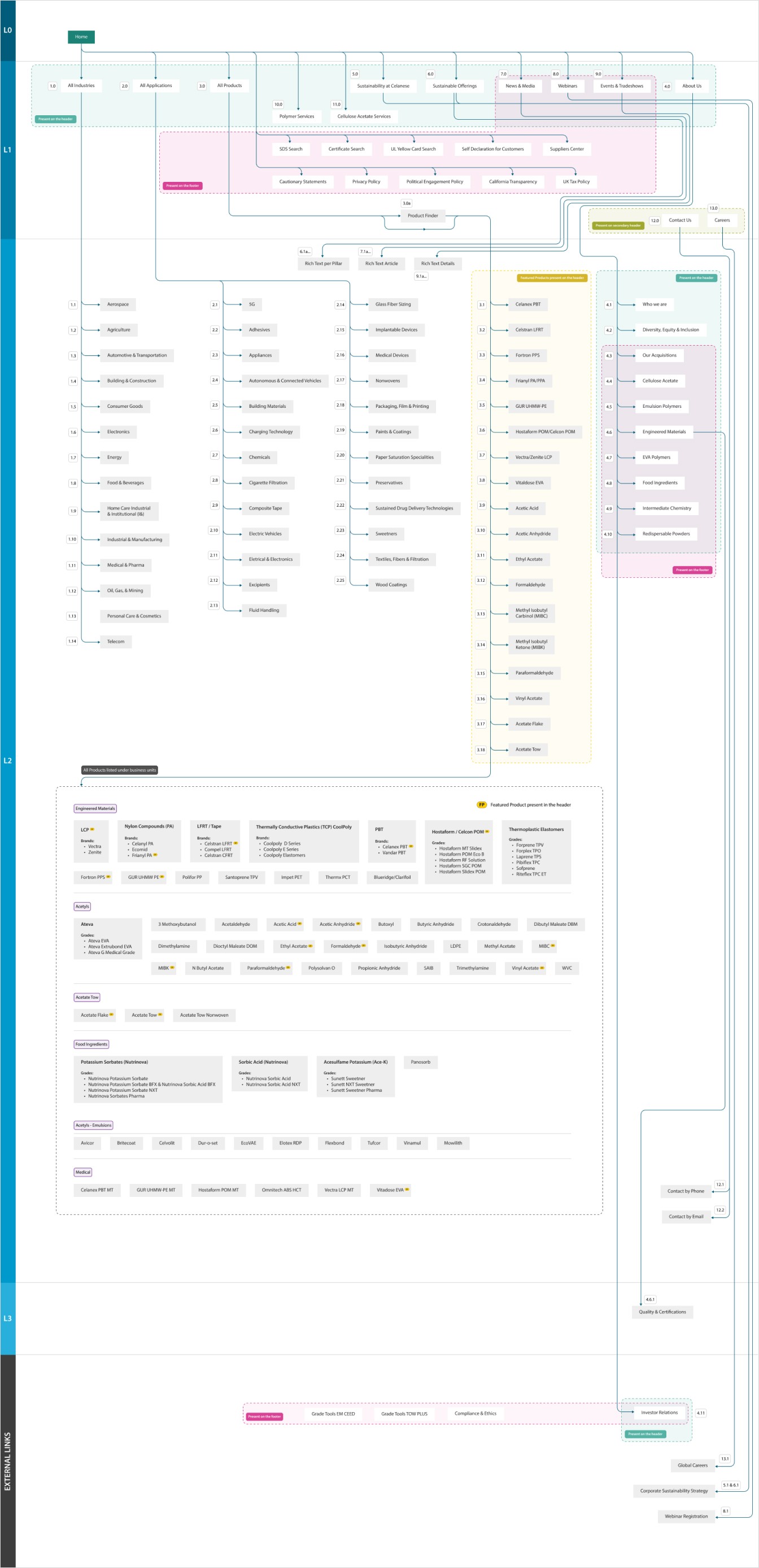
a Living Style Guide
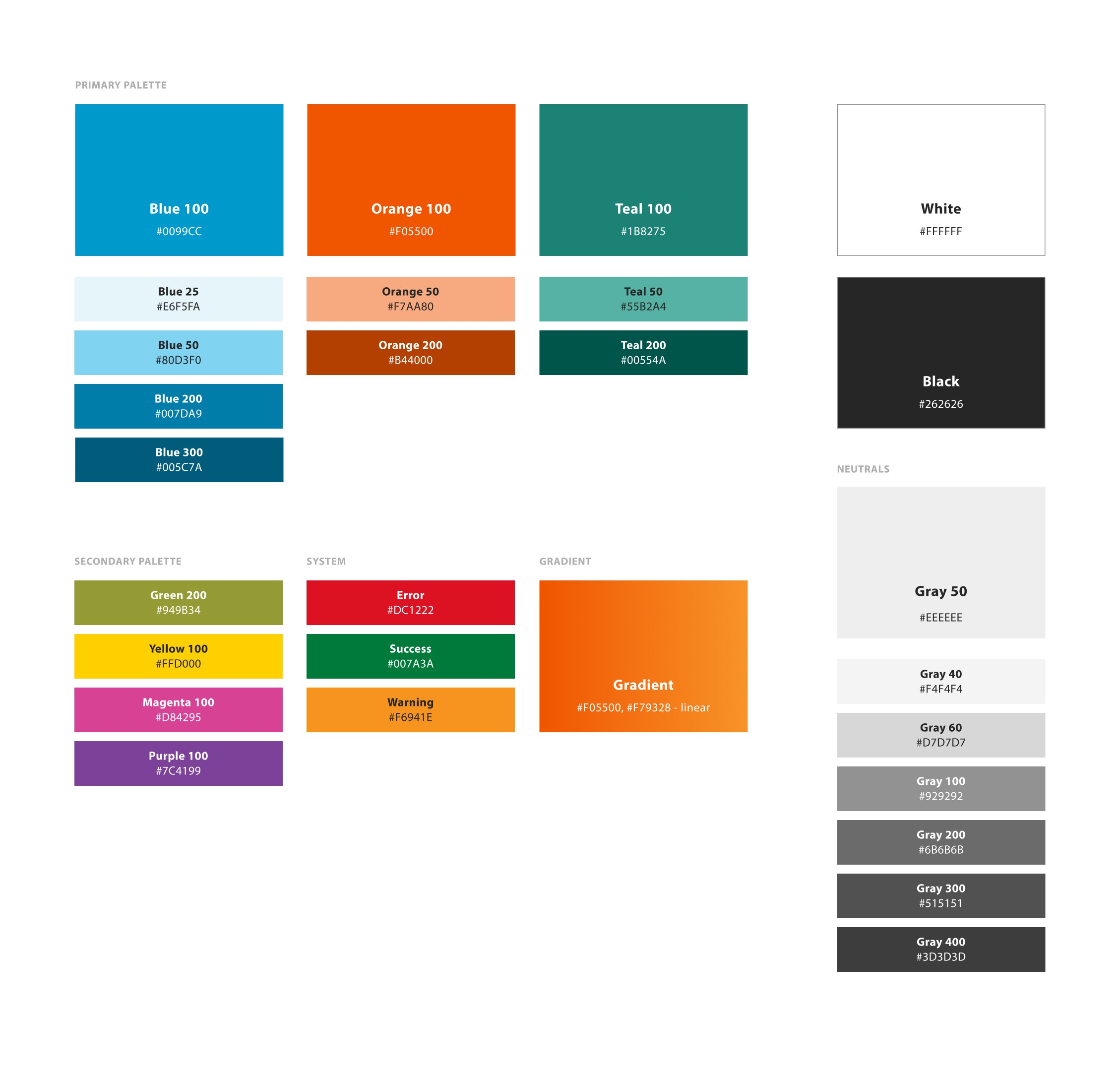
To aid in future growth, the agency provided a living style guide built in Figma. I was tasked with updating the documentation for use in prototyping new features and content. This guide serves as a touchpoint between our business partners and development. Well documented guidelines help ensure the long term design integrity of Celanese.com.
Prototypes For The Win
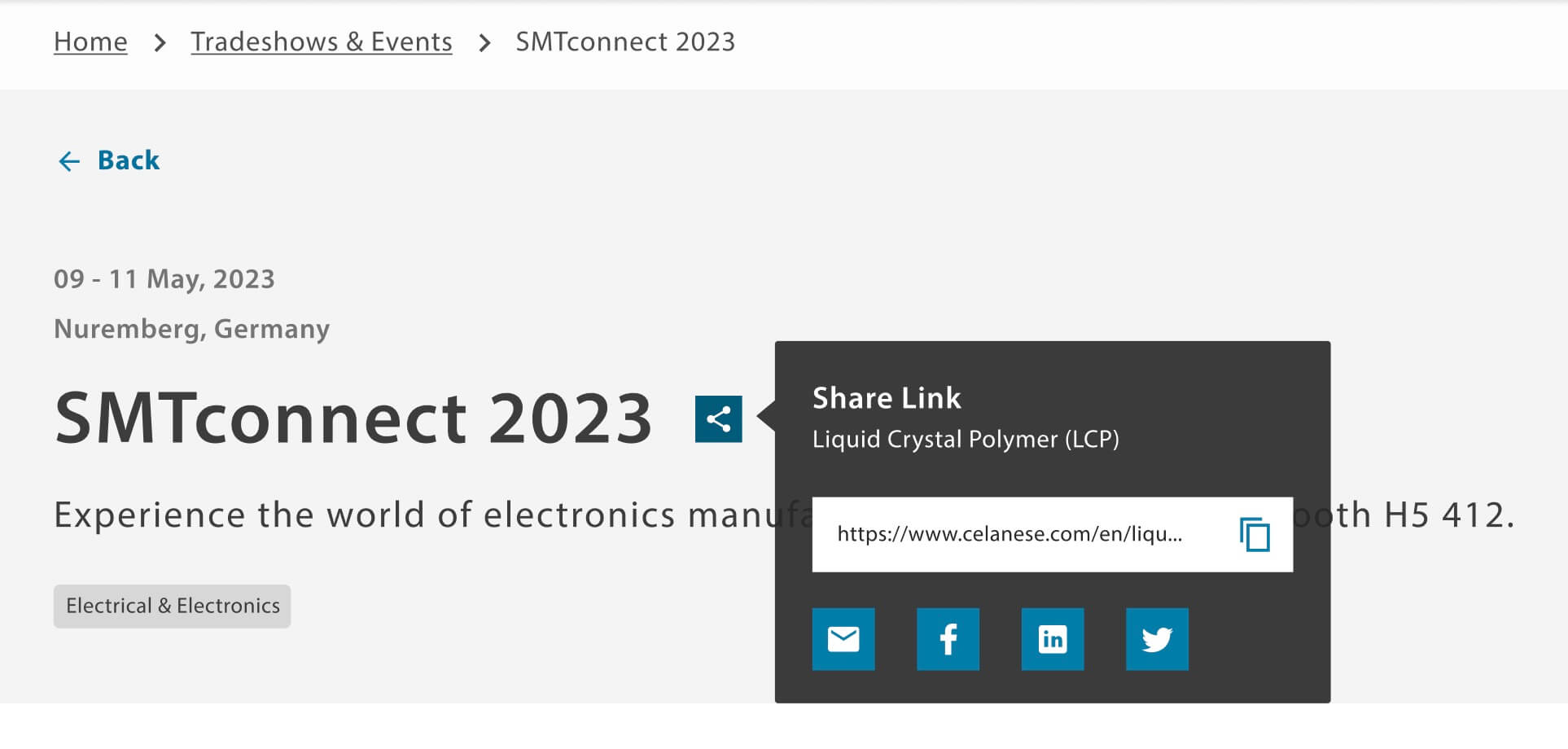
Using interactive prototypes helped the process along in many ways. Clients loved seeing our progress and being able to interact and experience new content for themselves. The prototypes conveyed the UX we were shooting for much better than any high fidelity mockup could.
hindsight is 20/20
As more and more content is added from various sources, my job is to carefully consider how we will implement these changes leveraging the design system.
For instance, our business partners noticed that some pages were very heavy with content on the left of the screen, having lots of whitespace on the right side. I prototyped a solution using an alternating text/photo layout that was implemented.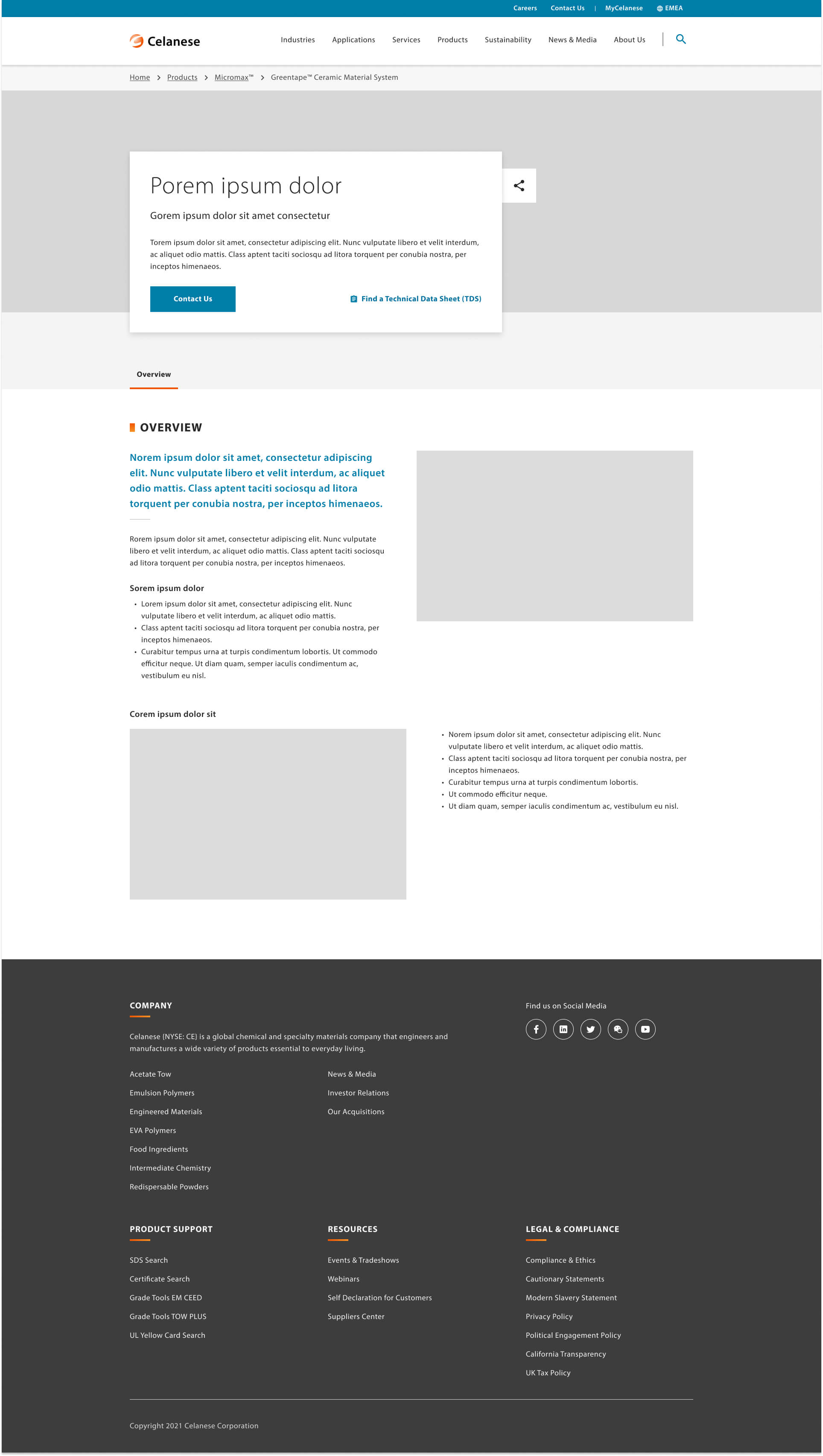
COMPLEX COMPONENTS
Using design system components also reduces time-to-market, with faster design and development cycles due to design asset and code reuse at scale. My number one job managing the design system is to make decisions about when to use already designed components, when to alter, and when to create something new.
where we started
Some of the challenges before redesigning: the website was responsive only using breakpoints so the content resized inconsistently, there was no design system so there were conflicting button and formatting styles, and the main carousel images contained embedded text.
Once we understood these and a number of other issues, we could start the process of who are users were and what they needed from the new website.personas
Personas create a shared understanding of who the users truly are. In addition, they help our teams in having a common vocabulary. These personas helped us empathize, reduced biases, and reminded us to design our users' mental and behavioral models rather than our businesses' organizational or engineering implementation models.
user journeys & site map
A Journey Mapping workshop was conducted with the Celanese product managers and other stakeholders to visualize a user's process to accomplish a goal.
The Sitemap helped in redesigning the navigation for the site. It allows visitors and content authors to find specific pages in their hierarchy and aids in indexing.a Living Style Guide
To aid in future growth, the agency provided a living style guide built in Figma. I was tasked with updating the documentation for use in prototyping new features and content. This guide serves as a touchpoint between our business partners and development. Well documented guidelines help ensure the long term design integrity of Celanese.com.
Prototypes For The Win
Using interactive prototypes helped the process along in many ways. Clients loved seeing our progress and being able to interact and experience new content for themselves. The prototypes conveyed the UX we were shooting for much better than any high fidelity mockup could.
hindsight is 20/20
As more and more content is added from various sources, my job is to carefully consider how we will implement these changes leveraging the design system.
For instance, our business partners noticed that some pages were very heavy with content on the left of the screen, having lots of whitespace on the right side. I prototyped a solution using an alternating text/photo layout that was implemented.COMPLEX COMPONENTS
Using design system components also reduces time-to-market, with faster design and development cycles due to design asset and code reuse at scale. My number one job managing the design system is to make decisions about when to use already designed components, when to alter, and when to create something new.
where we started
Some of the challenges before redesigning: the website was responsive only using breakpoints so the content resized inconsistently, there was no design system so there were conflicting button and formatting styles, and the main carousel images contained embedded text.
Once we understood these and a number of other issues, we could start the process of who are users were and what they needed from the new website.personas
Personas create a shared understanding of who the users truly are. In addition, they help our teams in having a common vocabulary. These personas helped us empathize, reduced biases, and reminded us to design our users' mental and behavioral models rather than our businesses' organizational or engineering implementation models.
user journeys & site map
A Journey Mapping workshop was conducted with the Celanese product managers and other stakeholders to visualize a user's process to accomplish a goal.
The Sitemap helped in redesigning the navigation for the site. It allows visitors and content authors to find specific pages in their hierarchy and aids in indexing.a Living Style Guide
To aid in future growth, the agency provided a living style guide built in Figma. I was tasked with updating the documentation for use in prototyping new features and content. This guide serves as a touchpoint between our business partners and development. Well documented guidelines help ensure the long term design integrity of Celanese.com.
Prototypes For The Win
Using interactive prototypes helped the process along in many ways. Clients loved seeing our progress and being able to interact and experience new content for themselves. The prototypes conveyed the UX we were shooting for much better than any high fidelity mockup could.
hindsight is 20/20
As more and more content is added from various sources, my job is to carefully consider how we will implement these changes leveraging the design system.
For instance, our business partners noticed that some pages were very heavy with content on the left of the screen, having lots of whitespace on the right side. I prototyped a solution using an alternating text/photo layout that was implemented.COMPLEX COMPONENTS
Using design system components also reduces time-to-market, with faster design and development cycles due to design asset and code reuse at scale. My number one job managing the design system is to make decisions about when to use already designed components, when to alter, and when to create something new.
where we started
Some of the challenges before redesigning: the website was responsive only using breakpoints so the content resized inconsistently, there was no design system so there were conflicting button and formatting styles, and the main carousel images contained embedded text.
Once we understood these and a number of other issues, we could start the process of who are users were and what they needed from the new website.personas
Personas create a shared understanding of who the users truly are. In addition, they help our teams in having a common vocabulary. These personas helped us empathize, reduced biases, and reminded us to design our users' mental and behavioral models rather than our businesses' organizational or engineering implementation models.
user journeys & site map
A Journey Mapping workshop was conducted with the Celanese product managers and other stakeholders to visualize a user's process to accomplish a goal.
The Sitemap helped in redesigning the navigation for the site. It allows visitors and content authors to find specific pages in their hierarchy and aids in indexing.a Living Style Guide
To aid in future growth, the agency provided a living style guide built in Figma. I was tasked with updating the documentation for use in prototyping new features and content. This guide serves as a touchpoint between our business partners and development. Well documented guidelines help ensure the long term design integrity of Celanese.com.
Prototypes For The Win
Using interactive prototypes helped the process along in many ways. Clients loved seeing our progress and being able to interact and experience new content for themselves. The prototypes conveyed the UX we were shooting for much better than any high fidelity mockup could.
hindsight is 20/20
As more and more content is added from various sources, my job is to carefully consider how we will implement these changes leveraging the design system.
For instance, our business partners noticed that some pages were very heavy with content on the left of the screen, having lots of whitespace on the right side. I prototyped a solution using an alternating text/photo layout that was implemented.COMPLEX COMPONENTS
Using design system components also reduces time-to-market, with faster design and development cycles due to design asset and code reuse at scale. My number one job managing the design system is to make decisions about when to use already designed components, when to alter, and when to create something new.
where we started
Some of the challenges before redesigning: the website was responsive only using breakpoints so the content resized inconsistently, there was no design system so there were conflicting button and formatting styles, and the main carousel images contained embedded text.
Once we understood these and a number of other issues, we could start the process of who our users were and what they needed from the new website.personas
Personas create a shared understanding of who the users truly are. In addition, they help our teams in having a common vocabulary. These personas helped us empathize, reduce biases, and remind us to design our users' mental and behavioral models rather than our businesses' organizational or engineering implementation models.
user journeys & site map
A Journey Mapping workshop was conducted with the Celanese product managers and other stakeholders to visualize a user's process to accomplish a goal.
The Sitemap helped in redesigning the navigation for the site. It allows visitors and content authors to find specific pages in their hierarchy and aids in indexing.a Living Style Guide
To aid in future growth, the agency provided a living style guide built in Figma. I was tasked with updating the documentation for use in prototyping new features and content. This guide serves as a touchpoint between our business partners and development. Well documented guidelines help ensure the long term design integrity of Celanese.com.
Prototypes For The Win
Using interactive prototypes helped the process along in many ways. Clients loved seeing our progress and being able to interact and experience new content for themselves. The prototypes conveyed the UX we were shooting for much better than any high fidelity mockup could.
hindsight is 20/20
As more and more content is added from various sources, my job is to carefully consider how we will implement these changes leveraging the design system.
For instance, our business partners noticed that some pages were very heavy with content on the left of the screen, having lots of whitespace on the right side. I prototyped a solution using an alternating text/photo layout that was implemented.COMPLEX COMPONENTS
Using design system components also reduces time-to-market, with faster design and development cycles due to design asset and code reuse at scale. My number one job managing the design system is to make decisions about when to use already designed components, when to alter, and when to create something new.
where we started
Some of the challenges before redesigning: the website was responsive only using breakpoints so the content resized inconsistently, there was no design system so there were conflicting button and formatting styles, and the main carousel images contained embedded text.
Once we understood these and a number of other issues, we could start the process of who our users were and what they needed from the new website.personas
Personas create a shared understanding of who the users truly are. In addition, they help our teams in having a common vocabulary. These personas helped us empathize, reduce biases, and remind us to design our users' mental and behavioral models rather than our businesses' organizational or engineering implementation models.
user journeys & site map
A Journey Mapping workshop was conducted with the Celanese product managers and other stakeholders to visualize a user's process to accomplish a goal.
The Sitemap helped in redesigning the navigation for the site. It allows visitors and content authors to find specific pages in their hierarchy and aids in indexing.a Living Style Guide
To aid in future growth, the agency provided a living style guide built in Figma. I was tasked with updating the documentation for use in prototyping new features and content. This guide serves as a touchpoint between our business partners and development. Well documented guidelines help ensure the long term design integrity of Celanese.com.
Prototypes For The Win
Using interactive prototypes helped the process along in many ways. Clients loved seeing our progress and being able to interact and experience new content for themselves. The prototypes conveyed the UX we were shooting for much better than any high fidelity mockup could.
hindsight is 20/20
As more and more content is added from various sources, my job is to carefully consider how we will implement these changes leveraging the design system.
For instance, our business partners noticed that some pages were very heavy with content on the left of the screen, having lots of whitespace on the right side. I prototyped a solution using an alternating text/photo layout that was implemented.COMPLEX COMPONENTS
Using design system components also reduces time-to-market, with faster design and development cycles due to design asset and code reuse at scale. My number one job managing the design system is to make decisions about when to use already designed components, when to alter, and when to create something new.
where we started
Some of the challenges before redesigning: the website was responsive only using breakpoints so the content resized inconsistently, there was no design system so there were conflicting button and formatting styles, and the main carousel images contained embedded text.
Once we understood these and a number of other issues, we could start the process of who our users were and what they needed from the new website.personas
Personas create a shared understanding of who the users truly are. In addition, they help our teams in having a common vocabulary. These personas helped us empathize, reduce biases, and remind us to design our users' mental and behavioral models rather than our businesses' organizational or engineering implementation models.
user journeys & site map
A Journey Mapping workshop was conducted with the Celanese product managers and other stakeholders to visualize a user's process to accomplish a goal.
The Sitemap helped in redesigning the navigation for the site. It allows visitors and content authors to find specific pages in their hierarchy and aids in indexing.a Living Style Guide
To aid in future growth, the agency provided a living style guide built in Figma. I was tasked with updating the documentation for use in prototyping new features and content. This guide serves as a touchpoint between our business partners and development. Well documented guidelines help ensure the long term design integrity of Celanese.com.
Prototypes For The Win
Using interactive prototypes helped the process along in many ways. Clients loved seeing our progress and being able to interact and experience new content for themselves. The prototypes conveyed the UX we were shooting for much better than any high fidelity mockup could.
hindsight is 20/20
As more and more content is added from various sources, my job is to carefully consider how we will implement these changes leveraging the design system.
For instance, our business partners noticed that some pages were very heavy with content on the left of the screen, having lots of whitespace on the right side. I prototyped a solution using an alternating text/photo layout that was implemented.COMPLEX COMPONENTS
Using design system components also reduces time-to-market, with faster design and development cycles due to design asset and code reuse at scale. My number one job managing the design system is to make decisions about when to use already designed components, when to alter, and when to create something new.
where we started
Some of the challenges before redesigning: the website was responsive only using breakpoints so the content resized inconsistently, there was no design system so there were conflicting button and formatting styles, and the main carousel images contained embedded text.
Once we understood these and a number of other issues, we could start the process of who our users were and what they needed from the new website.personas
Personas create a shared understanding of who the users truly are. In addition, they help our teams in having a common vocabulary. These personas helped us empathize, reduce biases, and remind us to design our users' mental and behavioral models rather than our businesses' organizational or engineering implementation models.
user journeys & site map
A Journey Mapping workshop was conducted with the Celanese product managers and other stakeholders to visualize a user's process to accomplish a goal.
The Sitemap helped in redesigning the navigation for the site. It allows visitors and content authors to find specific pages in their hierarchy and aids in indexing.a Living Style Guide
To aid in future growth, the agency provided a living style guide built in Figma. I was tasked with updating the documentation for use in prototyping new features and content. This guide serves as a touchpoint between our business partners and development. Well documented guidelines help ensure the long term design integrity of Celanese.com.
Prototypes For The Win
Using interactive prototypes helped the process along in many ways. Clients loved seeing our progress and being able to interact and experience new content for themselves. The prototypes conveyed the UX we were shooting for much better than any high fidelity mockup could.
hindsight is 20/20
As more and more content is added from various sources, my job is to carefully consider how we will implement these changes leveraging the design system.
For instance, our business partners noticed that some pages were very heavy with content on the left of the screen, having lots of whitespace on the right side. I prototyped a solution using an alternating text/photo layout that was implemented.COMPLEX COMPONENTS
Using design system components also reduces time-to-market, with faster design and development cycles due to design asset and code reuse at scale. My number one job managing the design system is to make decisions about when to use already designed components, when to alter, and when to create something new.
where we started
Some of the challenges before redesigning: the website was responsive only using breakpoints so the content resized inconsistently, there was no design system so there were conflicting button and formatting styles, and the main carousel images contained embedded text.
Once we understood these and a number of other issues, we could start the process of who our users were and what they needed from the new website.personas
Personas create a shared understanding of who the users truly are. In addition, they help our teams in having a common vocabulary. These personas helped us empathize, reduce biases, and remind us to design our users' mental and behavioral models rather than our businesses' organizational or engineering implementation models.
user journeys & site map
A Journey Mapping workshop was conducted with the Celanese product managers and other stakeholders to visualize a user's process to accomplish a goal.
The Sitemap helped in redesigning the navigation for the site. It allows visitors and content authors to find specific pages in their hierarchy and aids in indexing.a Living Style Guide
To aid in future growth, the agency provided a living style guide built in Figma. I was tasked with updating the documentation for use in prototyping new features and content. This guide serves as a touchpoint between our business partners and development. Well documented guidelines help ensure the long term design integrity of Celanese.com.
Prototypes For The Win
Using interactive prototypes helped the process along in many ways. Clients loved seeing our progress and being able to interact and experience new content for themselves. The prototypes conveyed the UX we were shooting for much better than any high fidelity mockup could.
hindsight is 20/20
As more and more content is added from various sources, my job is to carefully consider how we will implement these changes leveraging the design system.
For instance, our business partners noticed that some pages were very heavy with content on the left of the screen, having lots of whitespace on the right side. I prototyped a solution using an alternating text/photo layout that was implemented.COMPLEX COMPONENTS
Using design system components also reduces time-to-market, with faster design and development cycles due to design asset and code reuse at scale. My number one job managing the design system is to make decisions about when to use already designed components, when to alter, and when to create something new.
where we started
Some of the challenges before redesigning: the website was responsive only using breakpoints so the content resized inconsistently, there was no design system so there were conflicting button and formatting styles, and the main carousel images contained embedded text.
Once we understood these and a number of other issues, we could start the process of who our users were and what they needed from the new website.personas
Personas create a shared understanding of who the users truly are. In addition, they help our teams in having a common vocabulary. These personas helped us empathize, reduce biases, and remind us to design our users' mental and behavioral models rather than our businesses' organizational or engineering implementation models.
user journeys & site map
A Journey Mapping workshop was conducted with the Celanese product managers and other stakeholders to visualize a user's process to accomplish a goal.
The Sitemap helped in redesigning the navigation for the site. It allows visitors and content authors to find specific pages in their hierarchy and aids in indexing.a Living Style Guide
To aid in future growth, the agency provided a living style guide built in Figma. I was tasked with updating the documentation for use in prototyping new features and content. This guide serves as a touchpoint between our business partners and development. Well documented guidelines help ensure the long term design integrity of Celanese.com.
Prototypes For The Win
Using interactive prototypes helped the process along in many ways. Clients loved seeing our progress and being able to interact and experience new content for themselves. The prototypes conveyed the UX we were shooting for much better than any high fidelity mockup could.
hindsight is 20/20
As more and more content is added from various sources, my job is to carefully consider how we will implement these changes leveraging the design system.
For instance, our business partners noticed that some pages were very heavy with content on the left of the screen, having lots of whitespace on the right side. I prototyped a solution using an alternating text/photo layout that was implemented.COMPLEX COMPONENTS
Using design system components also reduces time-to-market, with faster design and development cycles due to design asset and code reuse at scale. My number one job managing the design system is to make decisions about when to use already designed components, when to alter, and when to create something new.
where we started
Some of the challenges before redesigning: the website was responsive only using breakpoints so the content resized inconsistently, there was no design system so there were conflicting button and formatting styles, and the main carousel images contained embedded text.
Once we understood these and a number of other issues, we could start the process of who our users were and what they needed from the new website.personas
Personas create a shared understanding of who the users truly are. In addition, they help our teams in having a common vocabulary. These personas helped us empathize, reduce biases, and remind us to design our users' mental and behavioral models rather than our businesses' organizational or engineering implementation models.
user journeys & site map
A Journey Mapping workshop was conducted with the Celanese product managers and other stakeholders to visualize a user's process to accomplish a goal.
The Sitemap helped in redesigning the navigation for the site. It allows visitors and content authors to find specific pages in their hierarchy and aids in indexing.a Living Style Guide
To aid in future growth, the agency provided a living style guide built in Figma. I was tasked with updating the documentation for use in prototyping new features and content. This guide serves as a touchpoint between our business partners and development. Well documented guidelines help ensure the long term design integrity of Celanese.com.
Prototypes For The Win
Using interactive prototypes helped the process along in many ways. Clients loved seeing our progress and being able to interact and experience new content for themselves. The prototypes conveyed the UX we were shooting for much better than any high fidelity mockup could.
hindsight is 20/20
As more and more content is added from various sources, my job is to carefully consider how we will implement these changes leveraging the design system.
For instance, our business partners noticed that some pages were very heavy with content on the left of the screen, having lots of whitespace on the right side. I prototyped a solution using an alternating text/photo layout that was implemented.COMPLEX COMPONENTS
Using design system components also reduces time-to-market, with faster design and development cycles due to design asset and code reuse at scale. My number one job managing the design system is to make decisions about when to use already designed components, when to alter, and when to create something new.
where we started
Some of the challenges before redesigning: the website was responsive only using breakpoints so the content resized inconsistently, there was no design system so there were conflicting button and formatting styles, and the main carousel images contained embedded text.
Once we understood these and a number of other issues, we could start the process of who our users were and what they needed from the new website.personas
Personas create a shared understanding of who the users truly are. In addition, they help our teams in having a common vocabulary. These personas helped us empathize, reduce biases, and remind us to design our users' mental and behavioral models rather than our businesses' organizational or engineering implementation models.
user journeys & site map
A Journey Mapping workshop was conducted with the Celanese product managers and other stakeholders to visualize a user's process to accomplish a goal.
The Sitemap helped in redesigning the navigation for the site. It allows visitors and content authors to find specific pages in their hierarchy and aids in indexing.a Living Style Guide
To aid in future growth, the agency provided a living style guide built in Figma. I was tasked with updating the documentation for use in prototyping new features and content. This guide serves as a touchpoint between our business partners and development. Well documented guidelines help ensure the long term design integrity of Celanese.com.
Prototypes For The Win
Using interactive prototypes helped the process along in many ways. Clients loved seeing our progress and being able to interact and experience new content for themselves. The prototypes conveyed the UX we were shooting for much better than any high fidelity mockup could.
hindsight is 20/20
As more and more content is added from various sources, my job is to carefully consider how we will implement these changes leveraging the design system.
For instance, our business partners noticed that some pages were very heavy with content on the left of the screen, having lots of whitespace on the right side. I prototyped a solution using an alternating text/photo layout that was implemented.COMPLEX COMPONENTS
Using design system components also reduces time-to-market, with faster design and development cycles due to design asset and code reuse at scale. My number one job managing the design system is to make decisions about when to use already designed components, when to alter, and when to create something new.
The Results 🎯
The Results 🎯
The Results 🎯
43% increased average time on page.
43% decrease in bounce rate.
February 2023 through May 2023 compared to February 2022 through May 2022
Supporting Campaign Materials
Supporting Campaign Materials
Supporting Campaign Materials
marking a century
As Celanese approached its centennial anniversary, I designed an interactive timeline of the company’s history. This prototype shows one of my first concepts showing a jagged line timeline along the bottom of the screen.
After testing with a sampling of employees, I took the feedback and tried a different direction. Although some of the UI from this early concept ended up in the final production site.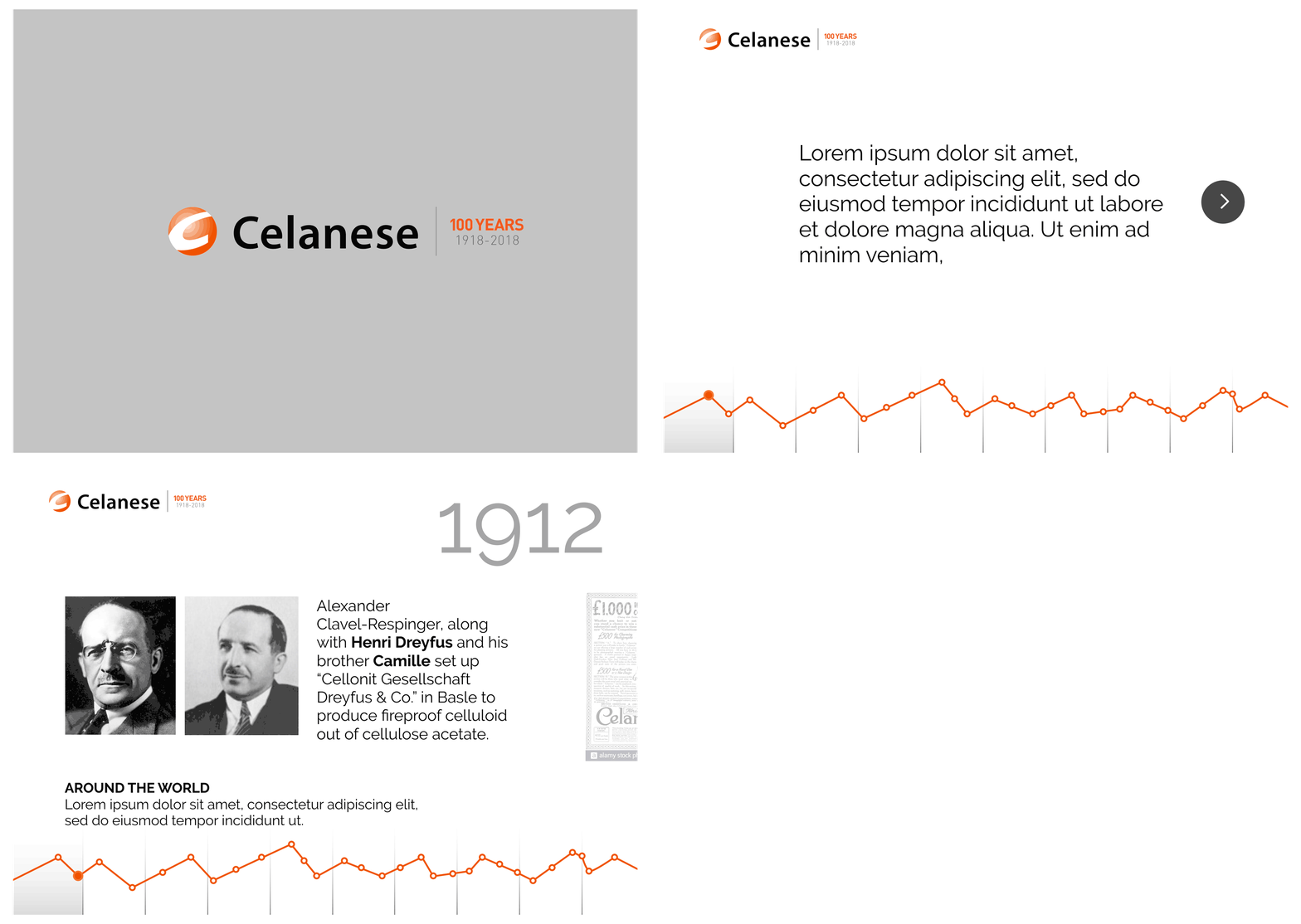
Exploring History
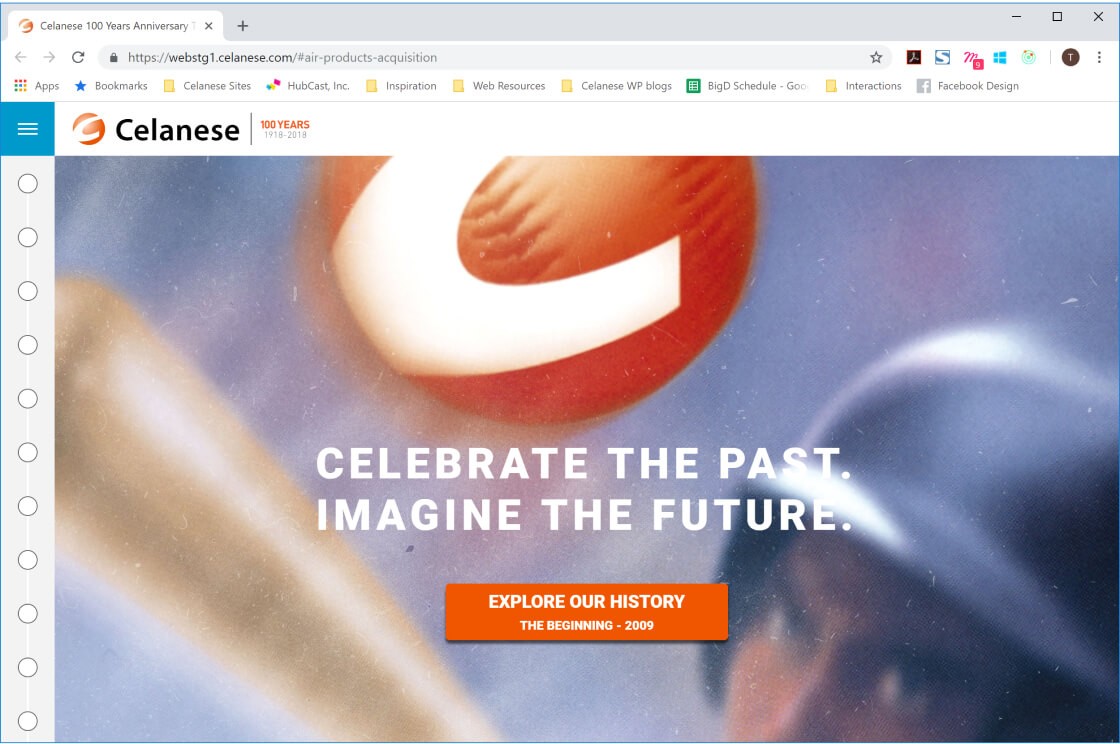
I was a major part of the historical photo/art research all the way to committing code to the repository. I looked through multiple dozens of company records in my search for interesting ads and artwork to display. I then had the materials photographed and I optimized them for the web.
a century of memories
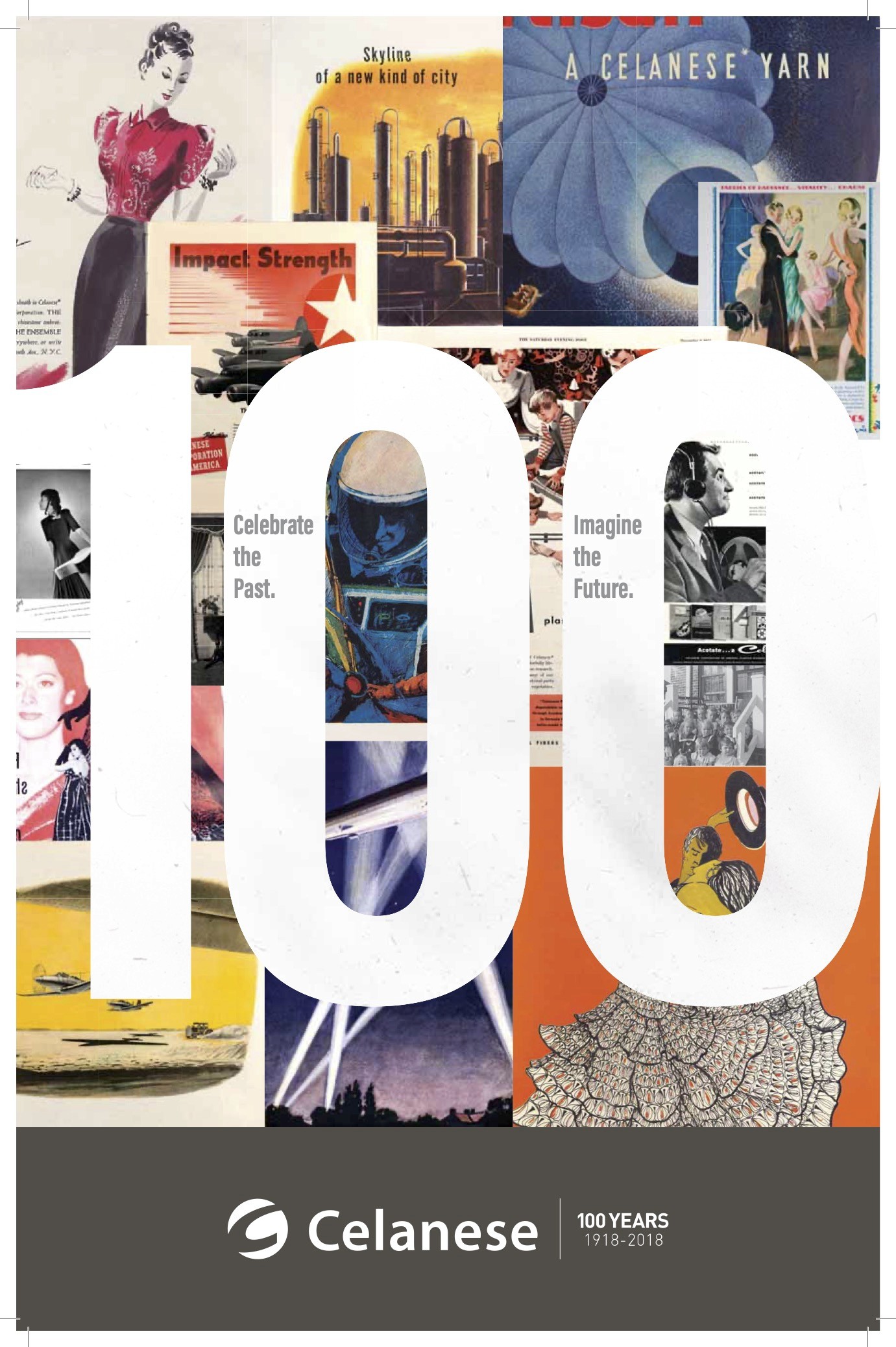
Part of the year long celebration was a commemorative book highlighting the history of Celanese from WW1 to the present. I designed this hard bound book to showcase the fantastic artwork and photography to immerse the reader in each decade.
how it started. how it’s going.
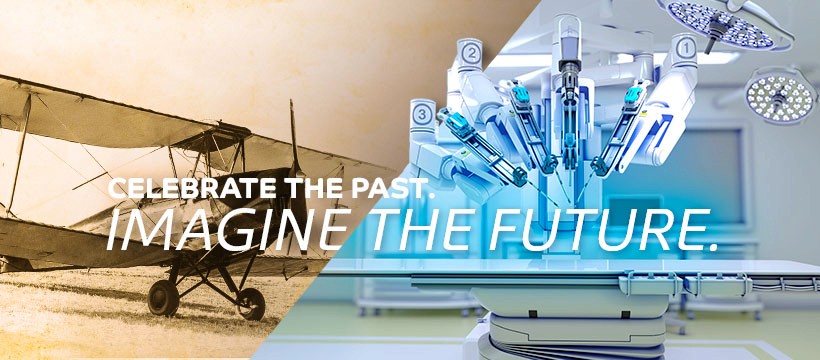
The external marketing for this campaign centered around “Celebrate the Past. Imagine the Future.” I designed multiple vignette’s showing how Celanese materials have been used in various industries in the past and going forward to the future.
my thumbprint on Celanese values
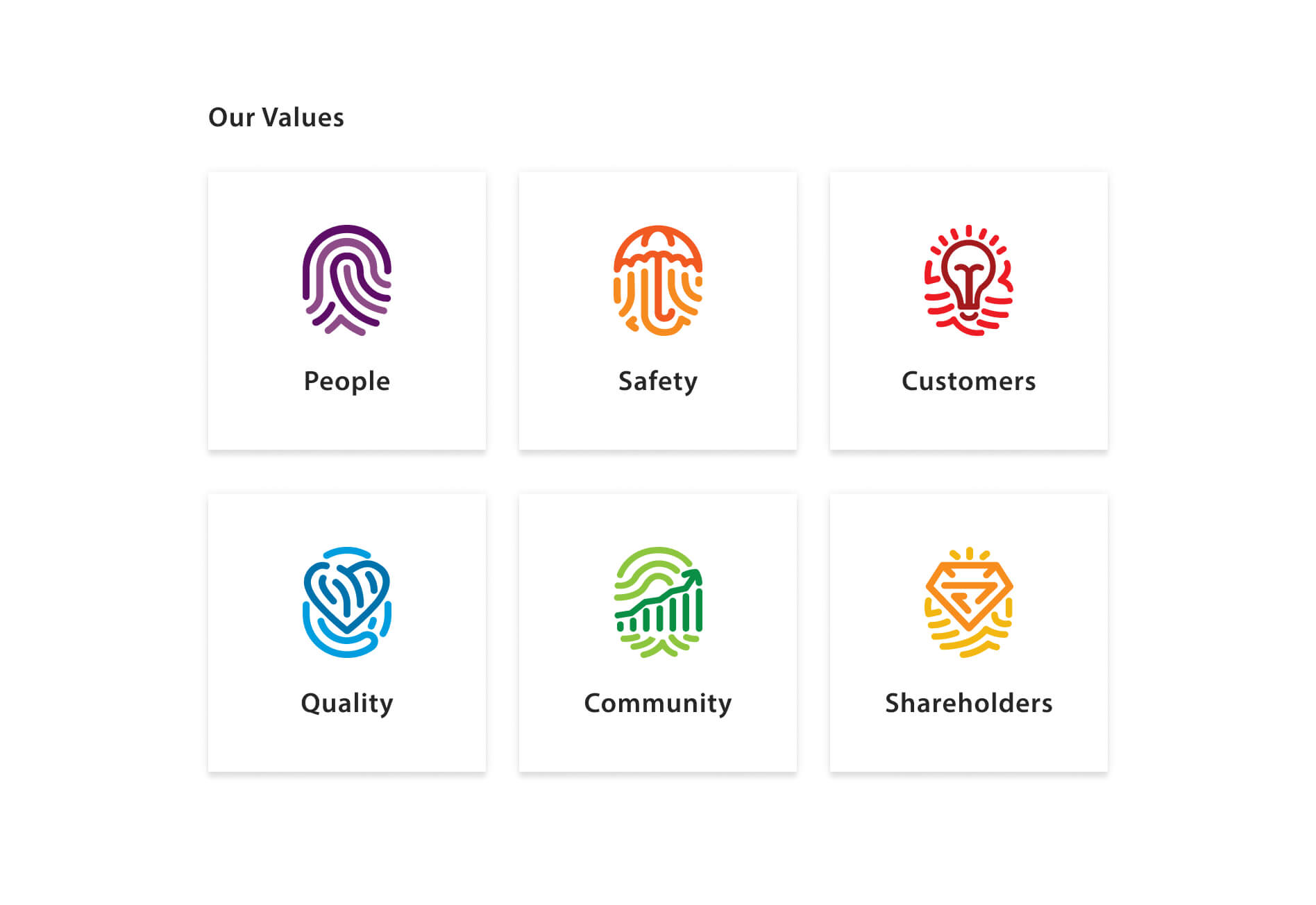
To celebrate the company’s new stated Values, I designed a cohesive set of icons in a fingerprint theme. These icons were produced on everything from posters to digital displays in offices, labs, and manufacturing sites all over the world.
marking a century
As Celanese approached its centennial anniversary, I designed an interactive timeline of the company’s history. This prototype shows one of my first concepts showing a jagged line timeline along the bottom of the screen.
After testing with a sampling of employees, I took the feedback and tried a different direction. Although some of the UI from this early concept ended up in the final production site.Exploring History
I was a major part of the historical photo/art research all the way to committing code to the repository. I looked through multiple dozens of company records in my search for interesting ads and artwork to display. I then had the materials photographed and I optimized them for the web.
a century of memories
Part of the year long celebration was a commemorative book highlighting the history of Celanese from WW1 to the present. I designed this hard bound book to showcase the fantastic artwork and photography to immerse the reader in each decade.
how it started. how it’s going.
The external marketing for this campaign centered around “Celebrate the Past. Imagine the Future.” I designed multiple vignette’s showing how Celanese materials have been used in various industries in the past and going forward to the future.
my thumbprint on Celanese values
To celebrate the company’s new stated Values, I designed a cohesive set of icons in a fingerprint theme. These icons were produced on everything from posters to digital displays in offices, labs, and manufacturing sites all over the world.
marking a century
As Celanese approached its centennial anniversary, I designed an interactive timeline of the company’s history. This prototype shows one of my first concepts showing a jagged line timeline along the bottom of the screen.
After testing with a sampling of employees, I took the feedback and tried a different direction. Although some of the UI from this early concept ended up in the final production site.Exploring History
I was a major part of the historical photo/art research all the way to committing code to the repository. I looked through multiple dozens of company records in my search for interesting ads and artwork to display. I then had the materials photographed and I optimized them for the web.
a century of memories
Part of the year long celebration was a commemorative book highlighting the history of Celanese from WW1 to the present. I designed this hard bound book to showcase the fantastic artwork and photography to immerse the reader in each decade.
how it started. how it’s going.
The external marketing for this campaign centered around “Celebrate the Past. Imagine the Future.” I designed multiple vignette’s showing how Celanese materials have been used in various industries in the past and going forward to the future.
my thumbprint on Celanese values
To celebrate the company’s new stated Values, I designed a cohesive set of icons in a fingerprint theme. These icons were produced on everything from posters to digital displays in offices, labs, and manufacturing sites all over the world.
marking a century
As Celanese approached its centennial anniversary, I designed an interactive timeline of the company’s history. This prototype shows one of my first concepts showing a jagged line timeline along the bottom of the screen.
After testing with a sampling of employees, I took the feedback and tried a different direction. Although some of the UI from this early concept ended up in the final production site.Exploring History
I was a major part of the historical photo/art research all the way to committing code to the repository. I looked through multiple dozens of company records in my search for interesting ads and artwork to display. I then had the materials photographed and I optimized them for the web.
a century of memories
Part of the year long celebration was a commemorative book highlighting the history of Celanese from WW1 to the present. I designed this hard bound book to showcase the fantastic artwork and photography to immerse the reader in each decade.
how it started. how it’s going.
The external marketing for this campaign centered around “Celebrate the Past. Imagine the Future.” I designed multiple vignette’s showing how Celanese materials have been used in various industries in the past and going forward to the future.
my thumbprint on Celanese values
To celebrate the company’s new stated Values, I designed a cohesive set of icons in a fingerprint theme. These icons were produced on everything from posters to digital displays in offices, labs, and manufacturing sites all over the world.
marking a century
As Celanese approached its centennial anniversary, I designed an interactive timeline of the company’s history. This prototype shows one of my first concepts showing a jagged line timeline along the bottom of the screen.
After testing with a sampling of employees, I took the feedback and tried a different direction. Although some of the UI from this early concept ended up in the final production site.Exploring History
I was a major part of the historical photo/art research all the way to committing code to the repository. I looked through multiple dozens of company records in my search for interesting ads and artwork to display. I then had the materials photographed and I optimized them for the web.
a century of MEMORIES
Part of the year long celebration was a commemorative book highlighting the history of Celanese from WW1 to the present. I designed this hard bound book to showcase the fantastic artwork and photography to immerse the reader in each decade.
how it started. how it’s going.
The external marketing for this campaign centered around “Celebrate the Past. Imagine the Future.” I designed multiple vignette’s showing how Celanese materials have been used in various industries in the past and going forward to the future.
my thumbprint on Celanese values
To celebrate the company’s new stated Values, I designed a cohesive set of icons in a fingerprint theme. These icons were produced on everything from posters to digital displays in offices, labs, and manufacturing sites all over the world.
marking a century
As Celanese approached its centennial anniversary, I designed an interactive timeline of the company’s history. This prototype shows one of my first concepts showing a jagged line timeline along the bottom of the screen.
After testing with a sampling of employees, I took the feedback and tried a different direction. Although some of the UI from this early concept ended up in the final production site.Exploring History
I was a major part of the historical photo/art research all the way to committing code to the repository. I looked through multiple dozens of company records in my search for interesting ads and artwork to display. I then had the materials photographed and I optimized them for the web.
a century of MEMORIES
Part of the year long celebration was a commemorative book highlighting the history of Celanese from WW1 to the present. I designed this hard bound book to showcase the fantastic artwork and photography to immerse the reader in each decade.
how it started. how it’s going.
The external marketing for this campaign centered around “Celebrate the Past. Imagine the Future.” I designed multiple vignette’s showing how Celanese materials have been used in various industries in the past and going forward to the future.
my thumbprint on Celanese values
To celebrate the company’s new stated Values, I designed a cohesive set of icons in a fingerprint theme. These icons were produced on everything from posters to digital displays in offices, labs, and manufacturing sites all over the world.
marking a century
As Celanese approached its centennial anniversary, I designed an interactive timeline of the company’s history. This prototype shows one of my first concepts showing a jagged line timeline along the bottom of the screen.
After testing with a sampling of employees, I took the feedback and tried a different direction. Although some of the UI from this early concept ended up in the final production site.Exploring History
I was a major part of the historical photo/art research all the way to committing code to the repository. I looked through multiple dozens of company records in my search for interesting ads and artwork to display. I then had the materials photographed and I optimized them for the web.
a century of MEMORIES
Part of the year long celebration was a commemorative book highlighting the history of Celanese from WW1 to the present. I designed this hard bound book to showcase the fantastic artwork and photography to immerse the reader in each decade.
how it started. how it’s going.
The external marketing for this campaign centered around “Celebrate the Past. Imagine the Future.” I designed multiple vignette’s showing how Celanese materials have been used in various industries in the past and going forward to the future.
my thumbprint on Celanese values
To celebrate the company’s new stated Values, I designed a cohesive set of icons in a fingerprint theme. These icons were produced on everything from posters to digital displays in offices, labs, and manufacturing sites all over the world.
marking a century
As Celanese approached its centennial anniversary, I designed an interactive timeline of the company’s history. This prototype shows one of my first concepts showing a jagged line timeline along the bottom of the screen.
After testing with a sampling of employees, I took the feedback and tried a different direction. Although some of the UI from this early concept ended up in the final production site.Exploring History
I was a major part of the historical photo/art research all the way to committing code to the repository. I looked through multiple dozens of company records in my search for interesting ads and artwork to display. I then had the materials photographed and I optimized them for the web.
a century of MEMORIES
Part of the year long celebration was a commemorative book highlighting the history of Celanese from WW1 to the present. I designed this hard bound book to showcase the fantastic artwork and photography to immerse the reader in each decade.
how it started. how it’s going.
The external marketing for this campaign centered around “Celebrate the Past. Imagine the Future.” I designed multiple vignette’s showing how Celanese materials have been used in various industries in the past and going forward to the future.
my thumbprint on Celanese values
To celebrate the company’s new stated Values, I designed a cohesive set of icons in a fingerprint theme. These icons were produced on everything from posters to digital displays in offices, labs, and manufacturing sites all over the world.
Follow me on LinkedIn
Selected case studies
© 2024 – Trevor Goodman
Follow me on LinkedIn
Selected case studies
© 2024 – Trevor Goodman
Follow me on LinkedIn
Selected case
studies
© 2024 – Trevor Goodman